Tuesday, June 17, 2014

Covers, part 1: Changes in book cover design


Going through the Createspace process has got me thinking of cover design for my novel, even though the version I’m printing this month (courtesy of the Nanowrimo prize) will just be printed for personal use and not published for public release. I have noticed that covers have changed a lot from what they were just a few years ago. In particular, it seems like covers with pictures of people have become much rarer. Many covers now show objects meant to symbolize something important to the story. If people are shown at all, we often only see parts of the character, such as just the feet, or everything but the head. I have seen several articles suggesting that symbolic objects are preferable on covers because they allow the readers to visualize the character in their own minds. For me, though, having a picture of a character never stopped me from visualizing the character for myself. Does anyone else lament the relative scarcity of people on book covers?

This blog posting is the first in a series of three on my thoughts about book cover design. In this post, I’ll look at two examples of books I first read and enjoyed many years ago and examine how their covers have changed over time. In the second post, I’ll examine recent covers from historical fiction books set in medieval times and explain why certain ones are especially good. In the third and final post on covers, I’ll turn my attention to possible cover designs for my own novel.

The first book cover I’ll discuss in this post is Children of the Night by Mercedes Lackey. Around the time it was first published (1990), I read a copy of the book with the following cover:

1990, Tor
The drawing of the intrepid, leather-clad heroine Diana facing the menacing clawed creature fit very well with the book.

A later cover showed a more mysterious-looking Diana on a foggy city street with huge, threatening eyes looming over the scene.

2005, Tor

Unfortunately, the new cover for the Kindle edition doesn’t show Diana at all. Like many books today, the cover only has symbolic objects related to events in the book: a guitar dripping with blood and a microphone and speaker bursting with loud sound waves.

2014, High Flight Arts and Letters

In this case the cover wouldn’t make a difference in whether or not I would buy the book; I would buy any new title featuring the character Diana Tregarde even if the publisher put a picture of a very full cat litter box on the cover. However, I would much rather see Diana or other characters on the cover than a collection of symbolic objects, even if they are related to the story.

The second book whose cover design changes I will examine here is Anne of Avonlea by Lucy Maud Montgomery. This is the second book of the Anne series, but it is the first one I read before I went on to read the entire series. When I was about sixteen, the age of Anne at the start of Anne of Avonlea, I came across a copy printed in 1909, the year the book first came out. It had a picture of Anne on the front, with her hair styled in the manner of the time. I still have this copy and re-read it from time to time.
 
1909, L. C. Page & Company

There have been hundreds of editions of Anne of Avonlea since then, so I cannot present them all here. I will just show representatives of various covers over the years since it was first published. Here is a more or less chronological list – in some cases, a cover may have first appeared earlier than the edition I found listed on Amazon or Goodreads.

1936, Grosset & Dunlap

1946, Ryerson

1949, George G Harrap and Co

1964, McGraw Hill

1971, Grossett & Dunlap

1984, Bantam

1987, Troll Communications L.L.C.

1998, Cherish Classics

2004, Scholastic

2006, Scholastic

2008, Davenport

2009, Ignacio Hills Press

2009, Puffin

2010, HarperFestival

2012, Tebbo

2013, Createspace (black and white plant)

2013, 1st World Publishing

2013, Createspace (forest)

2013, e-artnow

2014, Aladdin

2014, Createspace

2014, Sourcebooks Fire

2014, CL
Glancing down the list, it is clear that most of the earlier editions featured pictures of Anne, sometimes alone and sometimes with other characters. My favorites are the covers by Troll Communications (1987) and Cherish Classics (1998), which I think are particularly successful in capturing the personality of the main character.

Since the book entered the public domain (at least in the United States), there has been a proliferation of new editions. A few still show pictures of Anne, including the 2014 release by Sourcebooks Fire that features a new drawing of Anne along with drawings of a church and flowers. Other books show people, but not necessarily people who look like the actual characters as described by Montgomery. For example, the 2013 release by e-artnow shows a generic photo of people of that era. (Or at least, I think it is a generic picture. Without having an actual copy of the book, I cannot tell whether the individuals in the photo were selected for some reason, such as showing real PEI residents of the time period.)

Many of the recent covers do not show pictures of characters. One cover from 2014 (Aladdin) shows numerous symbolic objects drawn in white on a red background. Other covers show objects that are not especially symbolic. Several feature pictures of plants or natural scenes. The plants and the scenery could pass as being from PEI, but they could also be from elsewhere. Perhaps the most disappointing covers are a 2012 release with a generic pile of books shown on the cover and a 2013 cover showing only the words of the title and author within a decorative border.

Anne of Avonlea is such a wonderful book that I would encourage anyone to read whatever copy is available, regardless of the cover. Some recent covers have been creative and beautiful, but there have also been many that for me have not worked as well as most of the past covers featuring images of the beloved character Anne.

Both Children of the Night and Anne of Avonlea are superb books, but very different from the types of books I usually review on this blog. I chose them because they have both been in print long enough to acquire multiple covers and illustrate the changing trends in cover design. In the next posting in this series, I will specifically examine the covers of recent releases in historical fiction set in medieval times.

Monday, June 9, 2014

Book review: Edwin: High King of Britain by Edoardo Albert


Edwin: High King of Britain by Edoardo Albert is not the first historical novel focusing on this king from the first half of the seventh century. From the late 19th century, there is The Paladins of Edwin the Great by Clements Markham. More recent works include Flight of the Sparrow by Fay Sampson and the Bretwalda: The Story of Outlaw Prince Edwin trilogy by David Burks, but Albert’s contribution is the first recent work to draw the attention of a major press.


Albert is faithful to history as recounted by Bede and the Anglo-Saxon Chronicle, but his words breathe life into the ancient chronicles. Edwin, his older sons, and his advisors come across as very real characters with strengths and weaknesses. Albert depicts a harsh world in which kings are under pressure to engage in – and win – battles so as to provide activities and loot for their war bands. Being a king was a brutal calling, in which few lived long enough to see grey hairs on their royal heads.

Albert’s prose is simple, with just enough descriptions to set the scene and allow his well-developed characters to shine. The seventh century feels authentic as you read Edwin. Of course, there are many things we simply don’t know about life in the early seventh century, but Albert makes reasonable choices about details that remain unknown. There was only one area where I spotted a clear bending of time, when Æthelburh asks Paulinus if gifts have come from her mother or grandmother. At this time, both Bertha and Ingoberg would have been dead many years.

In addition to portraying several major battles, Albert also tells an important part of the story of the re-conversion of England to Christianity. Edwin is shown as a careful man who takes his time in deciding whether to convert. He asks many thoughtful questions and ponders the effects on those he governs. His choice is ultimately based mainly on who will provide more success on the battlefield – God, or the gods? This pragmatic approach was likely typical of this stage in history. Once the choice was made, Edwin was faithful to his decision.

If you have already read Bede’s Ecclesiastical History, you know more or less how the main outline of the story will end. But even with this knowledge, Edwin was an engaging and exciting read and I am looking forward to the next volume in the series. I recommend reading Edwin along with Hild by Nicola Griffith. Hild was Edwin’s niece and was not even mentioned in Albert’s book, which mainly focuses on life from the male perspective. Girffith’s Hild shows us the female perspective on early seventh century life.

I received this book from Netgalley in exchange for a fair review.

Monday, June 2, 2014

Mousse au chocolat à l’orange


My five-year old son enjoys watching some cooking shows, including a cartoon one called La cuisine est un jeu d’enfants (Cooking is child’s play), based on a cookbook with the same title by chef Michel Oliver. After watching, he really wanted to make their version of "chocolate pudding."

Drawings by five-year old of the cooking kids on the La cuisine est un jeu d'enfants cartoon


This recipe for chocolate mousse with orange is a fitting follow-up from my recent blog posting on medieval oranges. The recipe is not included in the cookbook, but my son watches the video over and over so I wrote down the ingredients and verified them against the recipe posted at Kalinka’s blog. The original recipe uses 8 eggs and is based on metric measurements, so I cut it to make about three-fourths the original quantity and adjusted some measurements slightly to use English measurements. Blogger Kalinka suggested an orange gelatin topping that was not part of Oliver’s original recipe, but it sounded good so I also adjusted it to English measurements.

Chocolate mousse with orange

Ingredients:

9 oz dark chocolate *
6 eggs, separated
Just over 10 tbsp butter, softened (150 g)
½ cup powdered sugar
Juice from 1 orange, small-medium
Pinch of salt

Mix the orange juice with the sugar in a saucepan and let it boil gently until it is somewhat thickened into a syrup. Remove from heat to cool.

Orange syrup


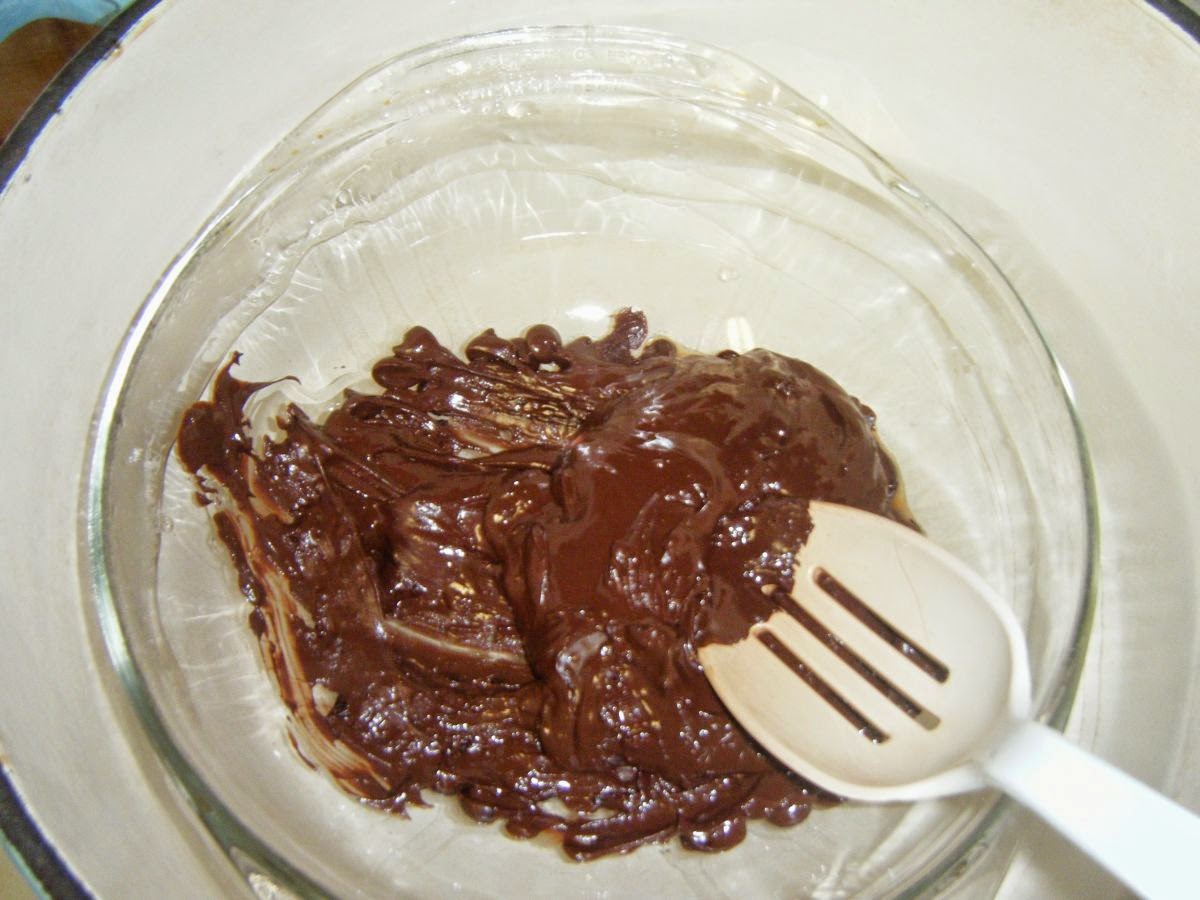
Melt the chocolate in a double boiler – you can devise one with a heatproof bowl in a pan of water.

Melting chocolate


Add the egg yolks and then the orange syrup.

Mixing the chocolate with egg yolks and orange syrup


Add a pinch of salt to the egg whites and beat until the peaks are slightly stiffened. Fold in the chocolate mixture.

Folding together the egg whites and chocolate mixture


Add to individual serving dishes if desired and cool in the refrigerator for several hours or overnight. Serve with the orange gelatin topping if desired.


With and without orange topping

Orange gelatin topping (optional)
About 2/3 cup orange juice (I used the juice from 2 oranges and 2 tangerines)
¼ cup powdered sugar
1 packet (7 g) plain gelatin

Mix the orange juice with the sugar in a saucepan and let it boil gently until it is somewhat thickened.
Mix the gelatin with about 3 tbsp water and add to the orange-gelatin mixture. Cook until firm.

The orange gelatin was good like this, but in the future I would add more orange juice (perhaps 1 cup?) to make it less stiff.

I enjoyed the mousse with the orange gelatin topping, but my five-year old preferred the mousse by itself.

Because this recipe contains raw eggs, I used pasteurized eggs. I also recommend using good-quality grass-fed butter if possible.

* Oliver specifies chocolate with at least 70% cacao, but it was difficult to find dark chocolate of known cacao concentration that didn’t have a warning about being processed on the same equipment as peanuts or tree nuts. I used a brand of chocolate chips with 65% cacao, which was the highest I could find that didn’t have the peanut warning, since we have a peanut and tree nut allergy in the household.

Sunday, June 1, 2014

First draft of novel completed


Today I finished the first draft of my novel, tentatively entitled Herb Enchanter. The main character is a 6th century sorcerer and healer in Kent, England. The book is historical fiction, not fantasy. Enchanter and sorcerer are modern words for early Anglo-Saxon practitioners who blended magic and medicine. I actually “finished” the writing around the middle of last week, but today I completed certain formatting changes so that it is now in a form for me to review and revise. I started writing with Nanowrimo on November 1 last year, and today the word count is at 102,202.

 
Medieval physicians, from the British Library manuscript Harley 1585, folio 9v. The British Library has made images from the Catalogue of Illuminated Manuscripts available under the Public Domain mark.

Of course, the novel is really far from finished. I still have substantial revisions and will need to completely re-write certain scenes. Nonetheless, it is a good feeling to have made it this far!

I plan to take advantage of the Nanowrimo offer from CreateSpace for two free paperback copies of the book. So my goals for June are to make an initial revision and format the novel for CreateSpace printing. It will almost certainly need more editing than a month will allow before I’ll have the novel ready to share publicly, but I think it will be helpful to go through the CreateSpace process to learn more about those steps in self-publishing.